Pillar 3a 2026 and 2027: maximum, deadline, catch-up
By the Rappenwise team. Last checked .
The pillar 3a maximum for employees with a pension fund is CHF 7,258 for 2026 and CHF 7,373 for 2027 (Federal Council, 2 October 2026). To count for 2026, the money has to be credited to your 3a account by 31 December 2026 (Federal Tax Administration), and your provider may set an earlier cut-off. If you start in November and plan to reach the 2026 maximum, that is two payments of CHF 3,629; for 2027, starting in January, it is CHF 614.42 a month.
New for 2026: if you did not pay the full amount for 2025, you can make up the gap for the first time. Every rule below links to the official page or law text behind it. This page is general information, not tax or financial advice, and it does not say whether 3a suits you.
How much can you pay into pillar 3a in 2026 and 2027?
| Maximum per person | 2026 | 2027 |
|---|---|---|
| With a pension fund (2nd pillar) | CHF 7,258 | CHF 7,373 |
| Without a pension fund | 20% of earned income, at most CHF 36,288 | 20% of earned income, at most CHF 36,864 |
The Federal Tax Administration (ESTV) confirmed that the 2026 amounts are unchanged from 2025. The 2027 amounts apply from 1 January 2027.
Where do the figures come from? The pillar 3a ordinance (BVV 3) sets the maximum at 8% of the BVG upper wage limit with a pension fund, and 20% of earned income up to 40% of that limit without one (Art. 7 para. 1). For 2027 the upper limit is CHF 92,160. Our arithmetic: 92,160 × 8% = 7,372.80, rounded to CHF 7,373; 92,160 × 40% = CHF 36,864.
Who can pay in: people with earned income subject to AHV, employed or self-employed, including people receiving unemployment insurance daily allowances. If both spouses work, each can pay up to their own maximum (Art. 7 para. 2). If you keep working past AHV reference age, you can pay in for up to five more years.
By when must the money be in?
For tax year 2026, the money has to be credited to your individual 3a account by 31 December 2026. ESTV's circular on pillar 3a (Kreisschreiben Nr. 18a, 22 December 2025) says a contribution must be paid "bis spätestens am 31. Dezember des betreffenden Jahres" (by 31 December of the year in question at the latest; section 5.1). If your Swiss tax liability ends during the year, for example because you leave Switzerland, the date is your last day of tax liability instead.
What the deadline means in practice:
- Credited, not ordered. The circular says the date is the day of the credit on your individual pension account or policy. Neither the debit from your own bank account nor a credit to the provider's general bank account is enough. This follows the Federal Supreme Court's BGE 148 II 556 (2C_259/2022, 7 December 2022); in that case, a transfer debited on Friday 29 December 2017 was credited to the 3a account only on 3 January 2018 and was too late for 2017.
- Your provider's cut-off can be earlier. Providers can set their own earlier processing cut-offs for year-end payments; check yours.
- The maximum is also the payment limit. ESTV: "Die Höchstabzüge bilden zugleich die massgeblichen Einzahlungslimiten" (the maximum deductions are also the relevant payment limits). Contributions above the limit have to be refunded (circular 18a, sections 5.1 and 9.1).
Why the calendar year is the unit: "Als Steuerperiode gilt das Kalenderjahr" (the tax period is the calendar year; Federal Act on Direct Federal Tax, Art. 40 para. 1).
How much per month, depending on when you start?
If you plan to reach the maximum, this is the arithmetic. Assumptions: you have a pension fund, you pay equal amounts from your start month to December, and each payment reaches the 3a account within its month. Without a pension fund, the 20% rule above applies instead, so we have no table for that case.
| You start in | Payments to December | 2026 (maximum CHF 7,258) | 2027 (maximum CHF 7,373) |
|---|---|---|---|
| January | 12 | – | CHF 614.42 |
| February | 11 | – | CHF 670.27 |
| March | 10 | – | CHF 737.30 |
| April | 9 | – | CHF 819.22 |
| May | 8 | – | CHF 921.63 |
| June | 7 | – | CHF 1,053.29 |
| July | 6 | – | CHF 1,228.83 |
| August | 5 | – | CHF 1,474.60 |
| September | 4 | – | CHF 1,843.25 |
| October | 3 | CHF 2,419.33 | CHF 2,457.67 |
| November | 2 | CHF 3,629.00 | CHF 3,686.50 |
| December | 1 | CHF 7,258.00 | CHF 7,373.00 |
Arithmetic: maximum ÷ payments left. Maximums from the Federal Council release of 2 October 2026. The 2026 column starts in October because the earlier months of 2026 are over. Amounts are rounded to the rappen, so some rows add up to a few rappen more or less than the maximum (12 × CHF 614.42 = CHF 7,373.04); set the last payment so the year's total is exactly the maximum.
One rounding detail for standing orders: 12 × CHF 604.80 is CHF 7,257.60, 40 rappen short of the 2026 maximum, and 12 × CHF 614.40 is CHF 7,372.80, 20 rappen short of 2027's. A slightly larger last payment closes the gap.
Already paid part of it? The formula is (maximum − paid so far) ÷ payments left. Two examples:
| Situation | Arithmetic | Per payment |
|---|---|---|
| 2026: CHF 2,000 paid so far, two payments left (November, December) | (7,258 − 2,000) ÷ 2 | CHF 2,629.00 |
| 2027: CHF 1,500 paid by the end of June, six payments left (July to December) | (7,373 − 1,500) ÷ 6 | CHF 978.83 |
Can you catch up on years you missed?
From 2026, yes, within limits. A catch-up payment is called an Einkauf (buy-in). The Federal Social Insurance Office (BSV) says: "Einkäufe können erstmals im Steuerjahr 2026 rückwirkend für 2025 gemacht werden" (buy-ins can be made for the first time in tax year 2026, retroactively for 2025). The conditions, from BVV 3 Art. 7a and 7b and the BSV page, confirmed in ESTV's circular 18a (section 5.6):
- Only gaps from 2025 onwards. Gaps from before the rule came into force on 1 January 2025 cannot be bought in (transitional provision).
- You need AHV-liable earned income both in the gap year and in the year of the buy-in.
- In the buy-in year, you first pay that year's full ordinary contribution.
- The buy-in is capped at the small maximum per year: CHF 7,258 in 2026, and never more than the total of your gaps (Art. 7a para. 2).
- Gaps can be bought in for the ten years before the buy-in ("in den zehn dem Einkauf vorangehenden Jahren", Art. 7a para. 1 a).
- One buy-in per gap year (Art. 7a para. 3), so one year's gap cannot be filled in instalments; one buy-in can cover several gap years. No buy-in once you have drawn the old-age benefit (para. 4).
- You apply in writing to your 3a provider, listing the gap years and amounts (Art. 7b). The buy-in is fully deductible from taxable income, like the ordinary contribution.
How does a catch-up work for a CHF 2,000 year in 2025?
Assumptions: employed in Switzerland for all of 2025 and all of 2026, in a pension fund in both years, paid CHF 2,000 into 3a for 2025, no other 3a payments for 2025.
| Step | Rule | CHF |
|---|---|---|
| 2025 maximum | CHF 7,258 from 2025 | 7,258 |
| 2025 gap | 7,258 − 2,000 | 5,258 |
| 2026: ordinary contribution first, in full | Art. 7a para. 1 c | 7,258 |
| 2026: buy-in for the 2025 gap (cap in 2026: 7,258) | Art. 7a para. 2 | 5,258 |
| Paid into 3a in 2026 | 7,258 + 5,258 | 12,516 |
If 2026 is too soon, the same 2025 gap can be bought in a later year, each time after that year's full ordinary contribution. Our reading of "the ten years before the buy-in": a buy-in made in 2035 still looks back to 2025 (2025 to 2034), so 2035 is the last year for a 2025 gap (as long as you are still working and not more than five years past your AHV reference age, Art. 7a para. 5). That is our arithmetic from the law text, not a figure from an official page.
Arrived in Switzerland during 2025? Whether your 2025 gap is measured against the full CHF 7,258 is a question for your 3a provider or cantonal tax office. Your provider may also have its own processing cut-off for buy-in requests; check yours.
Taxed at source: how do you get the deduction?
If tax is deducted from your salary at source (Quellensteuer; for residents without a C permit, for example B-permit holders), your 3a payments are not taken into account automatically. ESTV says you claim them through a subsequent ordinary assessment (nachträgliche ordentliche Veranlagung, NOV), requested from your canton's tax office by 31 March of the following year. For 2026 payments that means by 31 March 2027.
ESTV calls this deadline a Verwirkungsfrist (forfeiture time limit) that cannot be extended: a late request is not considered. ESTV's circular 18a adds that the request is made in writing and that, once made, the ordinary assessment continues automatically in later years until you are no longer taxed at source (section 5.7 d, for people living in Switzerland).
What a NOV can mean for your tax bill, including a top-up or a refund, is in our guide to setting money aside for Swiss tax.
What does it save in tax?
It depends on your income, canton, municipality and household, so the only reliable figure is your own run of the ESTV tax calculator, which has a field for pillar 3a contributions.
We ran one hypothetical person through the ESTV calculator on 17 October 2026, with the same inputs as our CHF 100k salary guide: tax year 2026, City of Zurich (8001), single, age 35, no children, religion Other/None (no church tax), gross income CHF 100,000, net worth CHF 0, the calculator's default deductions. Then we ran it again with CHF 7,258 entered as "Contributions to pillar 3a pension plan". Tax year 2027 was not yet offered.
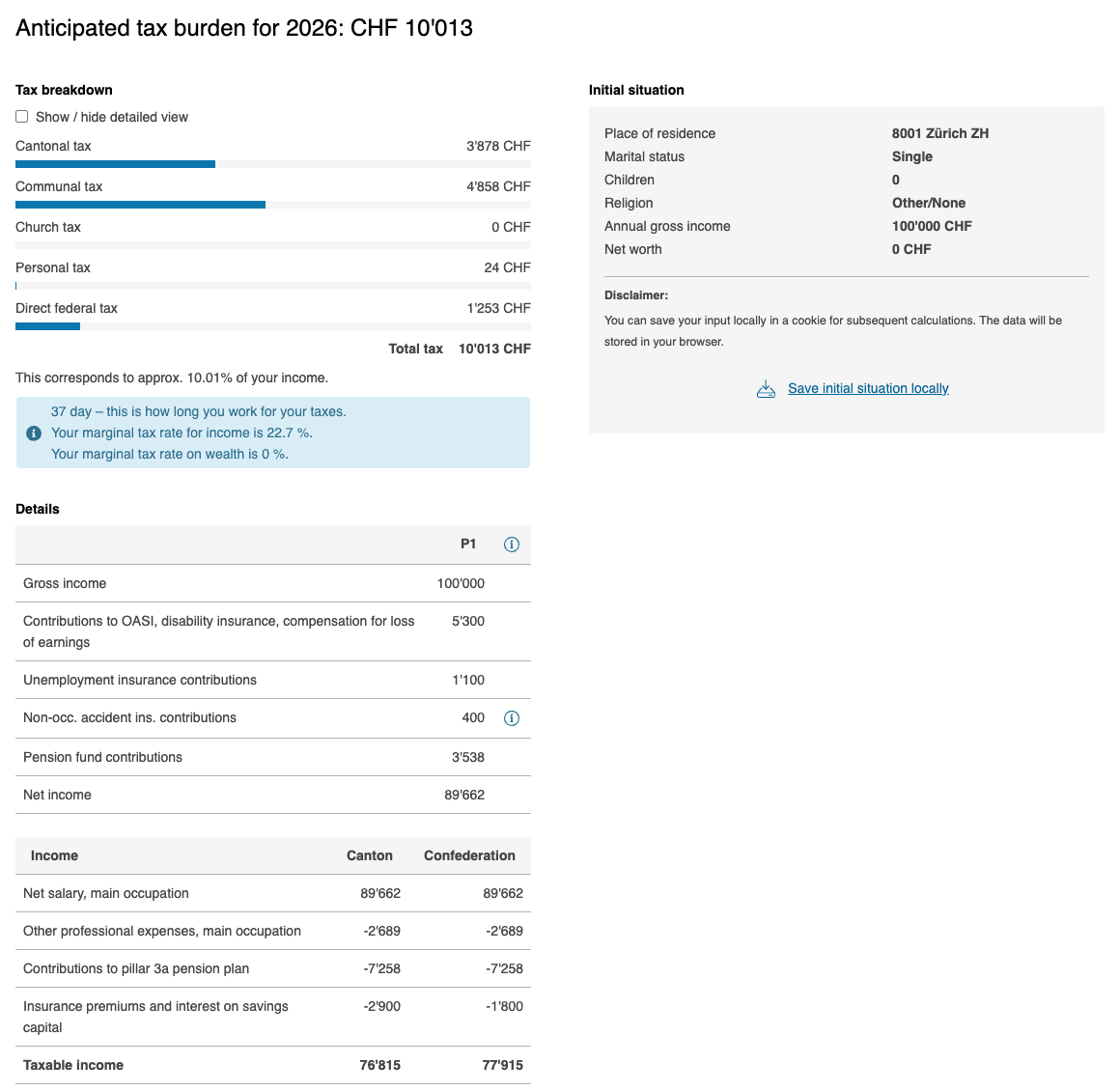
| ESTV calculator, tax year 2026, City of Zurich, single, CHF 100,000 | Without 3a | With CHF 7,258 in 3a | Difference |
|---|---|---|---|
| Cantonal tax | 4,494 | 3,878 | 616 |
| Communal tax (City of Zurich) | 5,629 | 4,858 | 771 |
| Personal tax | 24 | 24 | 0 |
| Direct federal tax | 1,701 | 1,253 | 448 |
| Total tax | 11,848 | 10,013 | 1,835 |
Arithmetic: 11,848 − 10,013 = 1,835 = 616 + 771 + 448. The taxable income in the calculator falls by exactly the CHF 7,258, at cantonal and at federal level.
In this example, the tax for 2026 is CHF 1,835 lower. The CHF 7,258 itself still comes out of that year's spending money: you move CHF 7,258 into 3a and pay CHF 1,835 less tax, so the money you can spend falls by CHF 7,258 − 1,835 = CHF 5,423, while the full CHF 7,258 is locked in 3a. ESTV says its results are "neither binding nor guaranteed".
For a married sole earner on the same CHF 100,000 in the City of Zurich, our tax set-aside guide shows the ESTV calculator's result for tax year 2026: CHF 1,308 less tax with CHF 7,258 in 3a, less than in the single example above.
What this means for your budget
If you pay into 3a, it is easier to plan as its own budget line, like rent, than to find the money in December. From the table above, that line is CHF 614.42 a month if you start in January 2027, or two payments of CHF 3,629 if you start in November 2026 and plan to reach the 2026 maximum.
The trade-off: money in 3a is normally locked until you are close to AHV retirement age, apart from a few legal exceptions, so it competes with your savings and any bigger costs coming up. Our CHF 100k salary guide sets out when 3a can be paid out. If your 13th salary is paid in November or December, that payout month is one place a year-end payment can come from; our 13th salary guide shows how much of it arrives.
If you are taxed the ordinary way, a 3a payment within the limit also lowers your tax bill, so your tax set-aside line can be based on the lower figure.
Any spreadsheet with one row for 3a and one column per month is enough for this. Our Swiss Budget Planner, which we sell, lets you rename categories, so you can add pillar 3a as a fixed monthly line next to rent and tax and see what is left to spend. Our free tools are on the tools page.
Sources and last checked
Checked against these official pages on 17 October 2026 (German pages with an English gloss).
- Federal Council, release of 2 October 2026 ("AHV/IV-Minimalrente steigt um 20 Franken"): pillar 3a maximums 2027, with the current 2026 figures.
- Federal Social Insurance Office (BSV), amounts valid from 1 January 2027, PDF, 2 October 2026 (pillar 3a maximums, BVG upper limit CHF 92,160).
- Federal Tax Administration (ESTV), circular no. 18a on pillar 3a, PDF (Kreisschreiben Nr. 18a, 22 December 2025), sections 5.1, 5.6, 5.7 and 9.1.
- ESTV, "Höchstabzüge Säule 3a im Steuerjahr 2026", 17 November 2025.
- BSV, "Die dritte Säule", updated 28 September 2026 (who can pay in, buy-in rules).
- Fedlex, ordinance on tax-deductible contributions to recognised pension schemes (BVV 3, SR 831.461.3), Art. 7, 7a, 7b and transitional provision, status 1 January 2025 (a version in force from 1 June 2027 changes only Art. 2).
- Federal Supreme Court, BGE 148 II 556 (2C_259/2022), judgment of 7 December 2022 (credit date for 3a payments at the year end).
- Fedlex, Federal Act on Direct Federal Tax (DBG, SR 642.11), Art. 33 and 40, status 1 January 2026.
- ESTV, Quellensteuer (tax at source), updated 22 September 2026 (FAQ on pillar 3a).
- ESTV, tax calculator, tax year 2026.