How much to set aside for taxes each month (2026)
By the Rappenwise team. Last checked .
Take your expected annual tax from the federal ESTV tax calculator and divide it by the months left before your canton wants the money. For a married sole earner on CHF 100,000 in the City of Zurich, the calculator shows CHF 8,269 for tax year 2026, so about CHF 892 a month from January to September, then CHF 82 a month, covers the Zurich part by the canton's 30 September interest date and the federal part by March 2027. If tax is deducted from your salary at source, you usually set aside nothing extra below CHF 120,000 a year, but from CHF 120,000 a tax return is mandatory and the difference comes as a bill or a refund.
This is general information, not tax advice. Cantons set their own payment dates and interest rates, so the Zurich figures apply to Zurich only.
How do I work out my monthly tax set-aside?
Three steps:
- Get your annual tax (T). Enter your canton, municipality, household and income into the ESTV tax calculator, run by the Federal Tax Administration. It splits the result into cantonal, communal, church and personal tax (the cantonal and municipal part) and the direct federal tax.
- Subtract what is already paid. Provisional payments you have made this year, or tax at source already deducted from your salary.
- Divide each part by the months until it is due. The cantonal part follows your canton's date; the federal part follows the federal date.
As formulas:
- Monthly for the canton = (cantonal, communal, church and personal tax − payments already made) / months left until your canton's interest date
- Monthly for the Confederation = direct federal tax / months left until it is due (for tax year 2026: due 1 March 2027, payable within 30 days)
- Your monthly set-aside = the two added together
Why split it? Because the two parts fall due at different times. In Zurich, the cantonal part is counted from 30 September of the tax year itself; the federal part only from the following spring. One flat amount for both either leaves you short in September or saves too early for the federal bill.
Worked example: CHF 100,000 in Zurich, tax year 2026
We entered these inputs into the ESTV calculator on 14 October 2026:
- Place of residence: 8001 Zürich (City of Zurich), tax year 2026
- Married, one earner (taxpayer 2: no income), no children, age 35 for both (the calculator's default)
- Religion "Other/None" for both, so no church tax
- Annual gross income CHF 100,000; net worth CHF 0
- No extra deductions entered (no pillar 3a); the calculator applies its own standard deductions
- Taxed ordinarily, for example a Swiss citizen or C-permit holder (the permit is not a calculator input)
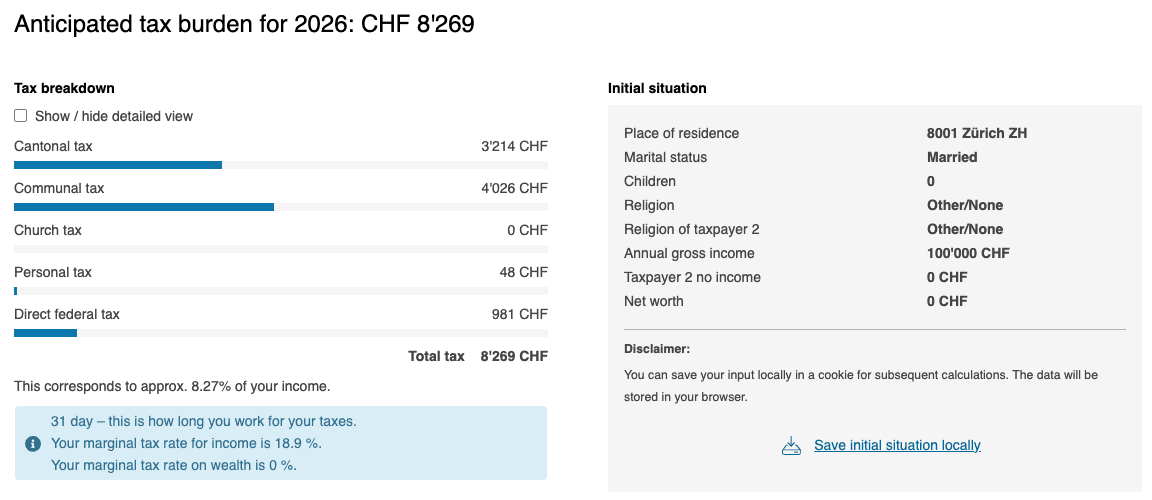
The calculator showed:
| Tax, 2026 | CHF |
|---|---|
| Cantonal tax | 3,214 |
| Communal tax (City of Zurich) | 4,026 |
| Church tax | 0 |
| Personal tax | 48 |
| Zurich part (canton + municipality) | 3,214 + 4,026 + 48 = 7,288 |
| Direct federal tax | 981 |
| Total | 7,288 + 981 = 8,269 |
That is about 8.27% of gross income. On the way there, the calculator deducts social contributions and its standard amounts from the CHF 100,000: taxable income comes to CHF 81,173 for the canton and CHF 80,473 for the federal tax. The calculator's own note says the result "is neither binding nor guaranteed", so treat CHF 8,269 as an estimate.
Step by step: the monthly amount
Zurich part. The canton counts 30 September 2026 as the interest date (more on that below). From January to September is 9 months:
7,288 / 9 = 809.78, so about CHF 810 a month.
Federal part. Due 1 March 2027 and payable within 30 days, so you can spread it over all 12 months of 2026:
981 / 12 = 81.75, so about CHF 82 a month.
Together:
| Months (2026) | Zurich part | Federal part | Set aside each month |
|---|---|---|---|
| January to September | 809.78 | 81.75 | 809.78 + 81.75 = 891.53, about CHF 892 |
| October to December | 0 | 81.75 | about CHF 82 |
Check: 9 × 809.78 = 7,288 (rounded) for Zurich, and 12 × 81.75 = 981 for the federal tax, together CHF 8,269.
What if I divide by 12 or start late?
Dividing the total by 12
8,269 / 12 = 689.08, so about CHF 689 a month. Simpler, but by 30 September you have saved 9 × 8,269 / 12 = 6,201.75, which is 7,288 − 6,201.75 = CHF 1,086.25 short of the Zurich part. Zurich charges 0.75% a year Ausgleichszins (balancing interest) on amounts still open after the interest date, until the final bill arrives. On CHF 1,086.25 that is 1,086.25 × 0.75% / 12 = about CHF 0.68 a month. It is a cost, not a fine; the flat rule works if you accept it.
Starting late
Fewer months left means a bigger monthly amount. For the Zurich part alone:
| You start saving in | Months to 30 September 2026 | Zurich part per month |
|---|---|---|
| January | 9 | 7,288 / 9 = CHF 809.78 |
| April | 6 | 7,288 / 6 = CHF 1,214.67 |
| July | 3 | 7,288 / 3 = CHF 2,429.33 |
Add the federal part on top. If you start in October 2026, the Zurich interest date has passed: the whole 7,288 is open and costs 0.75% a year Ausgleichszins until you pay or the final bill arrives, about 7,288 × 0.75% / 12 = CHF 4.56 a month. The federal 981 still has six months until 31 March 2027 (October to March): 981 / 6 = CHF 163.50 a month.
When is the money actually due?
Canton of Zurich
Zurich's government says the reference date for interest is "meistens" (usually) 30 September of the tax year. It is an interest date, not a cut-off: what changes on that day is which interest applies. Many cantons, including Zurich, send a provisional invoice during the tax year; check the amount on yours against your own calculator result.
| Interest, Canton of Zurich, from 1 January 2026 | Rate | When it applies |
|---|---|---|
| Vergütungszins (credit interest) | 0.75% | You pay before the interest date: the canton credits you |
| Ausgleichszins (balancing interest) | 0.75% | Tax still open between the interest date (Fälligkeit) and the final bill |
| Verzugszins (late-payment interest) | 4.5% | The final bill is not paid within 30 days |
The rates come from the Zurich government's amendment of 18 June 2025, in force from 1 January 2026.
So in Zurich, the expensive mistake is not paying the final bill on time (4.5%). Paying the provisional amount after 30 September costs 0.75% a year.
Direct federal tax
The direct federal tax for a tax year generally falls due on 1 March of the following year. Art. 161 DBG, in the Federal Act on Direct Federal Tax, leaves the date to the Federal Department of Finance, which sets it in Art. 1 of its ordinance on due date and interest. The tax then has to be paid within 30 days (Art. 163 DBG). For tax year 2026 that means by about 31 March 2027; Zurich sends the provisional federal invoice in March, payable by 31 March. Late payment costs 4.00% for tax year 2026 and 4.00% in 2027.
Other cantons
Payment dates, instalment options and interest rates differ by canton. The method stays the same; only the "months left" changes. Your canton's tax office page gives its due date and current rates, which set the divisor.
Does paying early earn anything?
Zurich part: a little. The canton pays 0.75% Vergütungszins in 2026 on payments made before the interest date. Paying the CHF 7,288 on 31 March instead of 30 September 2026 (183 days) earns about:
7,288 × 0.75% × 183 / 365 = about CHF 27.40
This is simple interest; the canton's own day count may give a slightly different figure.
Federal part: nothing. The interest on voluntary advance payments of direct federal tax is 0.00% for tax year 2026 and stays at 0.00% in 2027. Money kept in your own savings account until the bill arrives loses no federal interest.
Whether CHF 27 is worth tying up CHF 7,288 six months early depends on what else that money would do for you. The numbers above are there so you can compare.
I am taxed at source: do I need to set anything aside?
Tax at source (Quellensteuer) is deducted from salary for residents without a C permit (Niederlassungsbewilligung), for example B-permit holders. What you need to set aside depends on your gross employment income.
| Your situation | What happens | What to set aside |
|---|---|---|
| Gross employment income below CHF 120,000 a year, no other income or wealth to declare | The deduction is normally the end of it | Usually nothing extra |
| Below CHF 120,000, but you request a subsequent ordinary assessment (nachträgliche ordentliche Veranlagung, NOV), for example to claim pillar 3a | The canton recalculates your tax as if you were taxed ordinarily | Possibly the difference; it can also be a refund |
| Gross employment income from CHF 120,000 a year | A subsequent ordinary assessment is mandatory | Expected ordinary tax minus tax at source already deducted |
The rules behind this table:
- Voluntary NOV. The request goes to the tax office of your canton of residence by 31 March of the year after the income fell due. ESTV calls this a forfeiture time limit (Verwirkungsfrist) that cannot be extended: a late request is not considered. Check your canton's rules for what the request means for later years.
- Mandatory NOV from CHF 120,000. The Federal Department of Finance sets the threshold in Art. 9 of its source-tax ordinance (QStV). If both spouses earn, it applies when either spouse reaches it. Other income or wealth not taxed at source can also trigger it. Once it applies, it continues until you are no longer taxed at source, even if your income falls below the threshold again (Art. 9 para. 4 QStV; Canton Thurgau tax practice, version 2026-09).
How do I estimate the top-up if the assessment is mandatory?
- Run your household through the ESTV calculator to estimate the ordinary tax.
- Add up the tax at source on your payslips for the year (or multiply the monthly deduction by the months you will work).
- If step 1 is higher, set aside the difference, divided by the months until your canton's final bill is likely. If step 2 is higher, you can expect a refund.
At CHF 120,000 and above, the monthly deduction is best read as a prepayment, not your final tax. We have not modelled a source-tax figure here: the calculator does not compute tax at source, and the amount depends on your canton's tariff and your tariff code.
The tax return forms do not always come by themselves. In Thurgau, the tax office sends the return automatically when the CHF 120,000 threshold applies, but in some other cases of mandatory assessment you have to request the forms by 31 March of the year after the income fell due. Check your own canton's practice.
Does pillar 3a change the set-aside?
Yes: contributions to pillar 3a lower your taxable income and so your bill. The 2026 maximum for people with a pension fund is CHF 7,258, rising to CHF 7,373 in 2027 (without a pension fund the maximum is higher: CHF 36,288 in 2026 and CHF 36,864 in 2027).
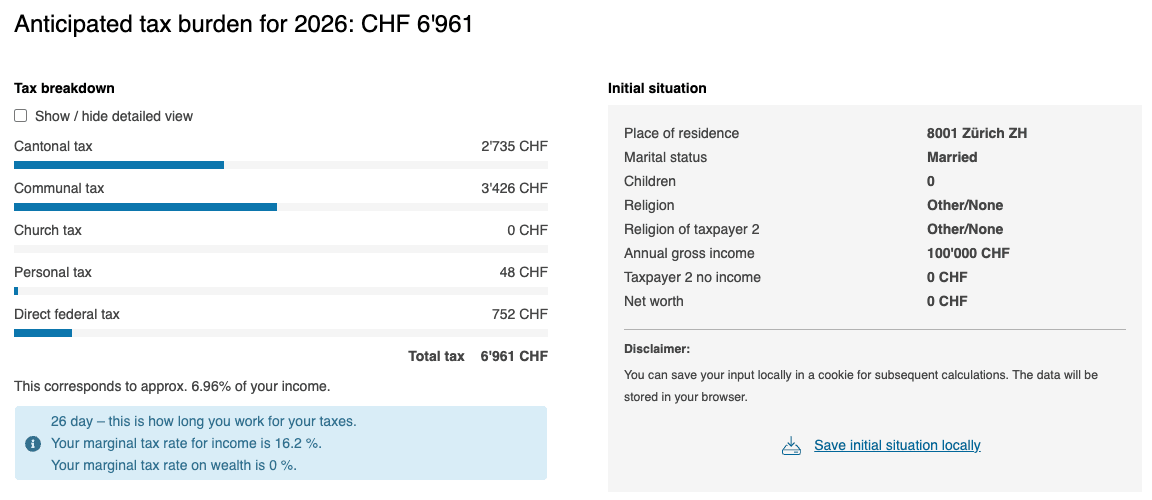
We re-ran the same Zurich household with CHF 7,258 entered as pillar 3a contributions:
| 2026, City of Zurich, married sole earner, CHF 100,000 | Without 3a | With CHF 7,258 in 3a |
|---|---|---|
| Zurich part (cantonal + communal + personal) | 7,288 | 2,735 + 3,426 + 48 = 6,209 |
| Direct federal tax | 981 | 752 |
| Total tax | 8,269 | 6,961 |
| Monthly, January to September | 891.53 | 6,209 / 9 + 752 / 12 = 689.89 + 62.67 = 752.56 |
| Monthly, October to December | 81.75 | 752 / 12 = 62.67 |
The tax bill is CHF 8,269 − 6,961 = CHF 1,308 lower. But the CHF 7,258 itself has to come from somewhere: it moves into your 3a account and is no longer money you can spend that year. In cash terms that year, you move CHF 7,258 and save CHF 1,308 in tax.
With 3a payments, the set-aside is based on the lower tax figure, and the 3a payment becomes its own line.
What this means for your budget
Tax works best as a budget line when it behaves like rent: a fixed monthly amount, moved on payday to a separate account you do not spend from. For the Zurich example that line is CHF 892 from January to September and CHF 82 from October to December (or CHF 753 and CHF 63 with a full 3a payment).
| Budget line, example household, 2026 | Per month |
|---|---|
| Tax set-aside, no 3a | CHF 892 (January to September), then CHF 82 |
| Tax set-aside, with CHF 7,258 in 3a | CHF 753 (January to September), then CHF 63 |
| Pillar 3a, if paid monthly | 7,258 / 12 = CHF 604.83 (all 12 months) |
Three things keep the line accurate:
- Re-run the calculator when something changes: a raise, a move to another municipality, a marriage, a child. Then recompute the monthly amount with the months that are left.
- Keep the other big fixed costs on their own lines. Health insurance premiums are not part of this tax line; our franchise break-even calculator helps with that one. Housing has its own extras, explained in Nebenkosten (service charges) in Switzerland, and a GA or Half Fare is a third fixed line, worked out in Is the GA worth it in 2027?.
- Compare with the provisional invoice when it arrives. If it is far from your own estimate, find out why before you change your monthly amount.
Any spreadsheet works: one row for the Zurich part divided by its months, one for the federal part divided by its months, one column per month. Our Swiss Budget Planner has a tax line set up that way next to the other fixed costs, so you can see what is left to spend each month.
Sources and last checked
Figures checked against these official pages on 14 October 2026 (German pages with an English gloss). The ESTV calculator offered tax year 2026 as its latest year on that day; we will recheck this page when 2027 becomes available.
- Federal Tax Administration (ESTV), tax calculator, version 2.1.3: both worked examples, run on 14 October 2026.
- Canton of Zurich, media release of 26 June 2025 ("Zinsen auf bezahlte Steuern leicht reduziert", interest on paid taxes slightly reduced) and the government decision of 18 June 2025, PDF (interest rates from 1 January 2026).
- ESTV, circular of 11 September 2025, PDF (direct federal tax, interest rates for tax year 2026) and release of 22 September 2026 (interest rates 2027).
- ESTV, Quellensteuer (tax at source), updated 22 September 2026.
- Canton Thurgau tax practice, StP 113 Nr. 3, mandatory subsequent ordinary assessment, version 2026-09.
- Federal Council, release of 2 October 2026 (pillar 3a maximums 2027).
- Fedlex: Federal Act on Direct Federal Tax (DBG), Art. 161 and 163 (status 2 September 2026); EFD ordinance on due date and interest of direct federal tax, Art. 1 (SR 642.124); EFD source-tax ordinance (QStV), Art. 9 (SR 642.118.2).
- Canton of Zurich, tax bill for private persons (Steuerrechnung für Privatpersonen) and the tax directive ZStB 173.1 on tax invoices (provisional invoice, 30 September).